
PSA Nitrogen Generation Technology
Pressure Swing Adsorption (PSA) nitrogen production uses air as the raw material and molecular sieves as the adsorbent. By exploiting the difference in adsorption rates between oxygen and nitrogen molecules on the molecular sieves—combined with a process involving pressurized adsorption and depressurized desorption for sieve regeneration—nitrogen is produced through the separation of oxygen and nitrogen at ambient temperature.
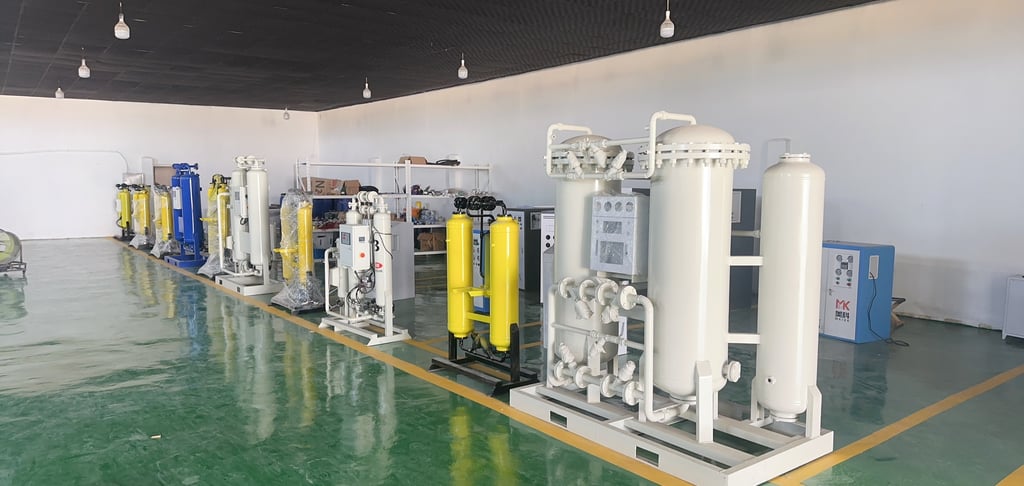
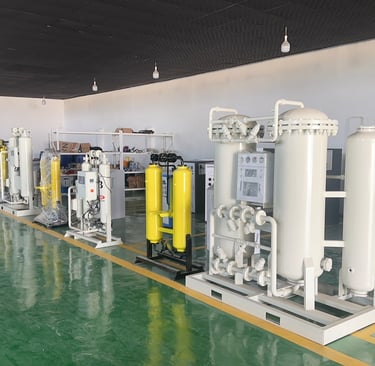
Nitrogen is chemically inert and generally does not react with other substances. Leveraging this inert nature, nitrogen is commonly used in anaerobic environments to provide isolation, flame retardation, explosion prevention, and corrosion protection. It finds applications in both industrial and civil sectors, such as the maintenance of light hydrocarbon units, LPG projects, and the purging of gas transmission pipelines and liquefied gas networks. Nitrogen also serves as a blanketing gas for processed food and pharmaceutical packaging, and is used for sealing cables and telephone lines, pressurizing inflatable rubber tires, and acting as a protective gas in metal processing.
PSA nitrogen generation uses air as the raw material and molecular sieves as the adsorbent. By exploiting the difference in adsorption rates between oxygen and nitrogen molecules on the molecular sieve—combined with a pressure swing adsorption process involving pressurized adsorption and depressurized desorption (which regenerates the sieve)—oxygen and nitrogen are separated at ambient temperature to produce nitrogen gas.
The PSA nitrogen generation process consists of three stages: air source compression, purification, and PSA separation.
Air Source Compression: Raw air is compressed by an air compressor and enters a wet air storage tank. Most oil, liquid water, and dust adhere to the vessel walls and drain to the bottom, where they are periodically discharged via a drain valve, while a portion travels with the airflow into the compressed air purification system.
Purification: The air purification system comprises a refrigerated dryer (or heated desiccant dryer), filters of varying precision ratings, and an oil removal unit. Through refrigeration-based dehumidification and multi-stage filtration (ranging from coarse to fine), liquid water, oil, and dust are removed from the compressed air. This process lowers the pressure dew point to 2–10°C, reduces oil content to 0.001 ppm, and filters out particles down to 0.01 μm, ensuring the cleanliness of the feed gas entering the PSA unit.
PSA Separation: The purified air is split into two streams and fed into two adsorption towers. A PLC controls the automatic switching of pneumatic valves, allowing the towers to alternate between adsorption and desorption cycles. This process separates the majority of the nitrogen from the oxygen in the air, venting the oxygen-enriched air to the atmosphere. Nitrogen enriched at the top of the tower is conveyed via piping to a downstream nitrogen storage tank; after undergoing online metering and analysis, it is delivered to the points of use.